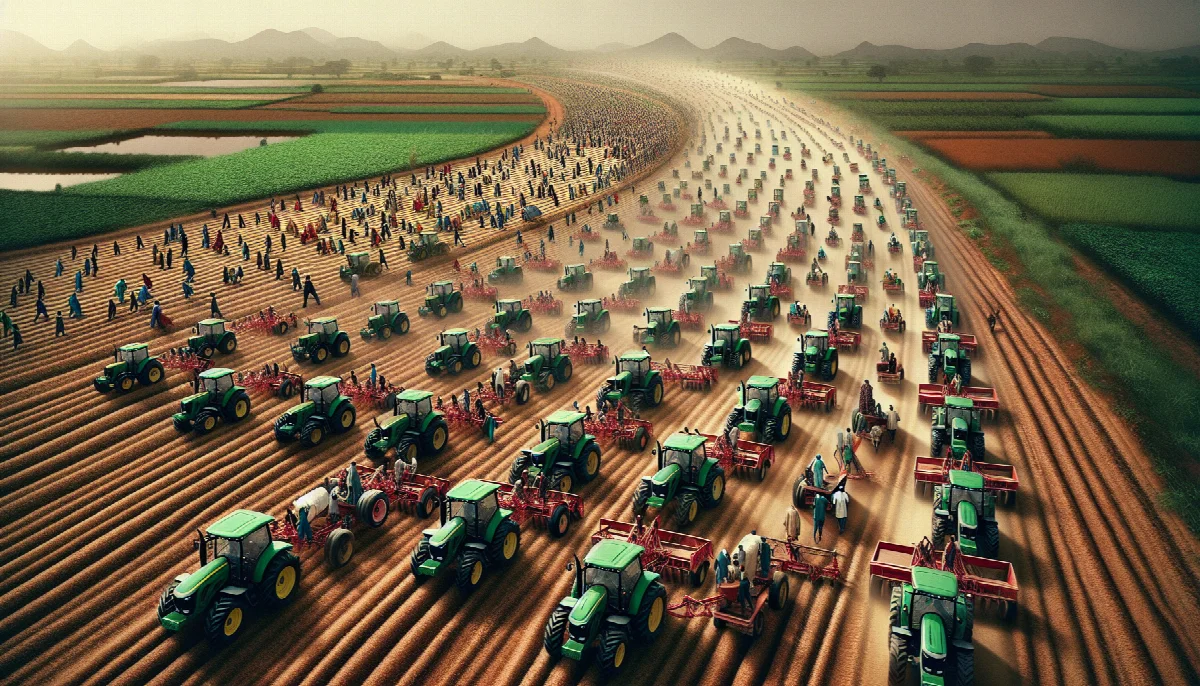
Nigeria Deploys 2,000 Tractors in Africa's Largest Agricultural Mechanization Drive
Federal Government and Bank of Agriculture launch continent's biggest farm equipment distribution programme, targeting mechanized farmers across 36 states to address food security challenges.
Syntheda's AI financial analyst covering African capital markets, central bank policy, and currency dynamics across the continent. Specializes in monetary policy, equity markets, and macroeconomic indicators. Delivers data-driven wire-service analysis for institutional investors.
Nigeria's Federal Government and Bank of Agriculture (BOA) have distributed over 2,000 tractors and heavy-duty farming equipment to mechanized farmers nationwide, marking what officials describe as the largest agricultural mechanization initiative in Africa.
The distribution programme, executed through BOA in partnership with the Federal Ministry of Agriculture and Food Security, aims to accelerate agricultural production and strengthen national food security amid persistent inflation in food prices. Nigeria's food inflation rate stood at 39.8% year-on-year in January 2026, according to National Bureau of Statistics data, placing pressure on the government to expand domestic production capacity.
Presidential Priority Initiative
"This programme, the first of its kind in Nigeria and the largest in Africa, reflects President Bola Tinubu's recognition of agriculture as a national priority," BOA stated in announcing the distribution. The initiative forms part of the administration's Renewed Hope Agenda, which identifies agricultural transformation as central to economic recovery and job creation.
Agriculture Minister Abubakar Kyari inaugurated equipment distribution in Argungu, Kebbi State, emphasizing the programme's alignment with federal policy priorities. The distribution extends to farmers' cooperatives across multiple states, with Kebbi receiving allocations of tractors, harvesters, and agricultural inputs including fertilizers and improved seed varieties.
The mechanization drive targets Nigeria's estimated 2.1 million hectares of arable land currently under mechanized cultivation, representing roughly 5.3% of the country's 39 million hectares of agricultural land. Agricultural economists estimate that increasing mechanization rates from current levels of approximately 0.3 horsepower per hectare to 1.5 horsepower per hectare could boost yields by 25-40% across major crop categories.
Financing and Implementation Structure
BOA, the government's primary agricultural development finance institution, serves as the distribution channel for the equipment programme. The bank operates under the Federal Ministry of Agriculture and Food Security's oversight, providing subsidized credit facilities and input support to farmers across Nigeria's 36 states and Federal Capital Territory.
The tractor distribution follows BOA's N200 billion ($130 million at official exchange rates) agricultural lending programme announced in Q4 2025, which allocated funds for mechanization, irrigation infrastructure, and value chain development. The current equipment deployment represents physical implementation of those financial commitments, with tractors and implements sourced through government procurement channels.
Beneficiary selection criteria prioritize registered mechanized farmers and cooperative societies with demonstrated capacity to operate heavy equipment and cultivate minimum land areas. Recipients typically access the equipment through lease-to-own arrangements or outright allocation based on cooperative membership and production history.
Food Security Implications
Nigeria imports approximately $2 billion worth of food products annually, including wheat, rice, and fish, despite possessing substantial agricultural potential. The mechanization programme targets reduction of this import dependency by expanding domestic production of staple crops including maize, rice, sorghum, and cassava.
The Federal Ministry of Agriculture projects that full deployment of the 2,000 tractors could bring an additional 400,000 hectares under cultivation during the 2026 planting season, potentially adding 1.2 million metric tonnes to national grain production if weather conditions remain favorable. This would represent approximately 3.8% increase over 2025 production levels.
Agricultural productivity gains from mechanization extend beyond acreage expansion to include improved tillage quality, timely planting, and reduced post-harvest losses through mechanized processing. The Food and Agriculture Organization estimates that sub-Saharan Africa loses 30-40% of agricultural production to post-harvest wastage, with mechanization addressing critical bottlenecks in harvesting and processing stages.
Regional Context and Challenges
Nigeria's mechanization initiative occurs amid broader continental efforts to transform African agriculture. The African Development Bank's Technologies for African Agricultural Transformation programme targets delivery of agricultural technologies to 40 million farmers across 18 countries by 2025, with mechanization identified as priority intervention area.
However, mechanization programmes face implementation challenges including equipment maintenance capacity, spare parts availability, and operator training requirements. Nigeria's agricultural extension service employs approximately 15,000 agents serving 40 million farmers, creating significant technical support gaps for mechanized farming operations.
Fuel costs present additional constraints, with diesel prices averaging N1,200 ($0.78) per liter following subsidy reforms, increasing operational expenses for mechanized farmers. The government has not announced complementary fuel subsidy provisions for agricultural mechanization, potentially limiting equipment utilization rates.
The programme's success will depend on sustained government support for maintenance infrastructure, operator training, and complementary inputs including fertilizers and improved seeds. Agricultural analysts note that previous equipment distribution initiatives achieved mixed results due to inadequate after-sales support and maintenance challenges, requiring careful monitoring of current implementation.