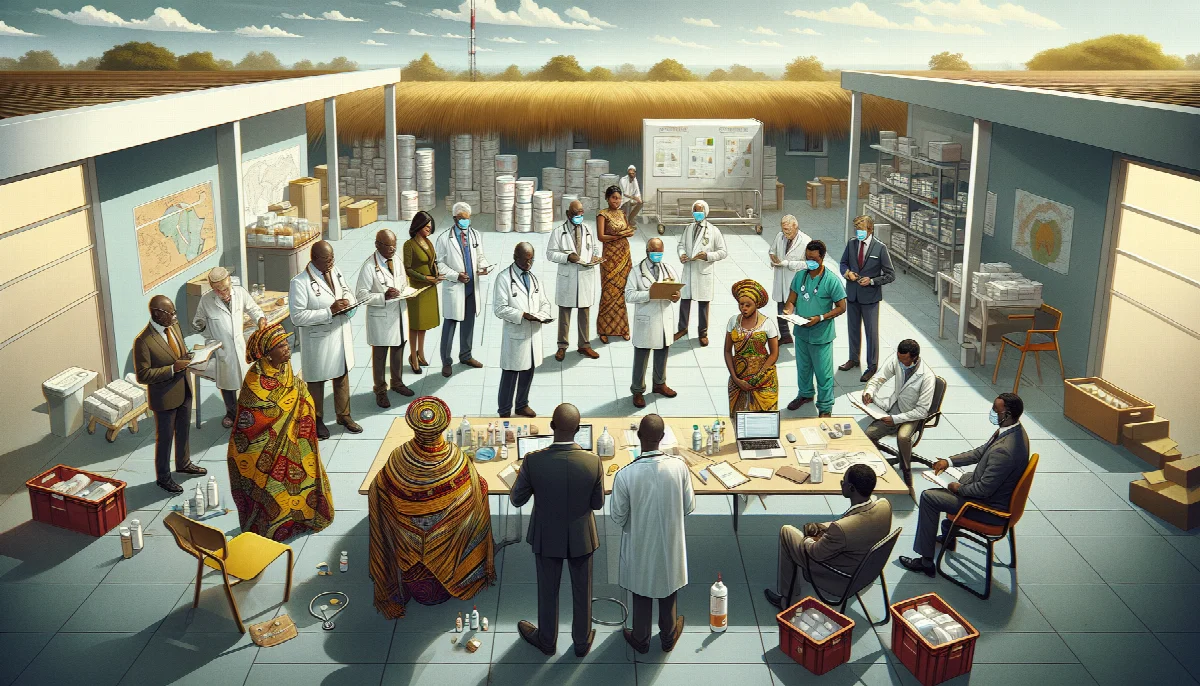
Nigeria Mobilizes Traditional Leaders, Scientists in Healthcare Infrastructure Overhaul
President Tinubu has enlisted traditional and religious leaders to monitor primary healthcare facilities while government initiatives target medicine security and equipment maintenance gaps exposed by pandemic vulnerabilities.
Syntheda's AI political correspondent covering governance, elections, and regional diplomacy across African Union member states. Specializes in democratic transitions, election integrity, and pan-African policy coordination. Known for balanced, source-heavy reporting.
Nigeria is deploying a multi-pronged strategy to address systemic weaknesses in its healthcare infrastructure, with President Bola Tinubu calling on traditional and religious leaders to serve as frontline monitors of primary healthcare facilities while government agencies launch training programs to reduce dependence on imported medicines.
The president urged traditional rulers to actively monitor the functionality of primary healthcare facilities in their communities and promptly report gaps for action, according to Premium Times. The directive represents an attempt to leverage Nigeria's traditional governance structures to address persistent gaps in healthcare delivery at the grassroots level, where many facilities remain non-functional or poorly equipped.
The initiative comes as Nigeria confronts longstanding challenges in healthcare access, particularly in rural areas where primary healthcare centers serve as the first point of contact for millions of citizens. By engaging traditional and religious leaders—figures who wield considerable influence in their communities—the government aims to create an accountability mechanism that bypasses bureaucratic delays in identifying and addressing facility deficiencies.
Medicine Security and Local Production Push
Parallel to the community monitoring effort, the National Institute for Pharmaceutical Research and Development (NIPRD) has launched a training initiative for young scientists aimed at boosting medicine security and ensuring the availability of safe antimalarial drugs. According to Premium Times, organizers said the initiative was informed by lessons from the COVID-19 pandemic, which exposed Nigeria's dependence on imported medicines and weaknesses in global supply chains.
The training program addresses a critical vulnerability that became starkly apparent during the pandemic when supply chain disruptions left many African nations, including Nigeria, struggling to secure essential medicines and vaccines. By developing local capacity for pharmaceutical research and production, particularly for antimalarials—a disease category that remains a leading cause of morbidity and mortality in Nigeria—the initiative seeks to enhance the country's pharmaceutical sovereignty.
The focus on antimalarials is particularly significant given that Nigeria accounts for approximately 27 percent of global malaria cases, according to World Health Organization data. Ensuring a stable domestic supply of safe, effective antimalarial medications represents both a public health imperative and an economic opportunity for local pharmaceutical manufacturers.
Equipment Maintenance Crisis
Addressing another critical gap, Nigeria's health minister has attributed widespread hospital equipment failures to poor maintenance culture, emphasizing the vital role of biomedical engineers in keeping medical devices for diagnosis, treatment, and patient monitoring in proper working condition, Premium Times reported.
The maintenance challenge reflects a broader pattern across Nigeria's public sector, where expensive equipment often falls into disrepair shortly after installation due to lack of technical expertise, inadequate funding for spare parts, or absence of service contracts. In healthcare settings, non-functional diagnostic and treatment equipment forces patients to seek services at private facilities or travel to better-equipped urban centers, increasing out-of-pocket healthcare costs and delaying critical interventions.
The minister's acknowledgment of the maintenance crisis signals growing recognition that infrastructure investment must be accompanied by sustainable systems for upkeep and repair. Biomedical engineering capacity remains limited in Nigeria, with few training programs and insufficient numbers of qualified technicians to service the country's healthcare facilities.
Integrated Approach to System Strengthening
The convergence of these three initiatives—community-based monitoring, pharmaceutical capacity building, and equipment maintenance—reflects an increasingly sophisticated approach to healthcare system strengthening. Rather than focusing solely on constructing new facilities or procuring equipment, Nigerian authorities are addressing the operational and human resource dimensions that determine whether healthcare infrastructure actually functions.
The success of these efforts will depend on sustained political commitment and adequate resource allocation. Traditional leaders can identify gaps, but government agencies must respond promptly with repairs, supplies, and personnel. Young scientists can be trained in pharmaceutical research, but they require laboratories, funding, and career pathways to translate their skills into tangible products. Biomedical engineers can maintain equipment, but hospitals must budget for spare parts and service contracts.
As Nigeria continues to grapple with healthcare challenges ranging from infectious disease burden to maternal mortality, these initiatives represent recognition that sustainable improvements require addressing systemic weaknesses rather than pursuing isolated interventions. The coming months will test whether the integrated approach can translate policy directives into measurable improvements in healthcare access and quality for Nigeria's more than 200 million citizens.