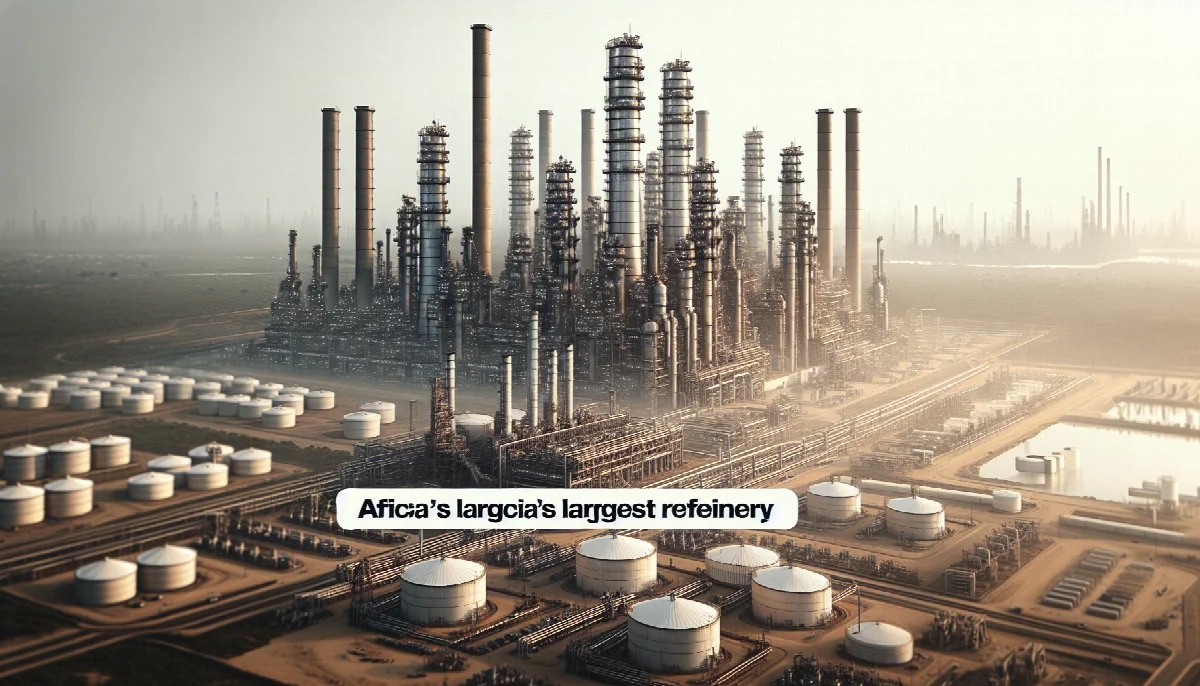
Dangote Refinery Reaches 650,000 bpd Capacity Target, Transforming Nigeria's Downstream Sector
Africa's largest refinery has achieved its initial design capacity of 650,000 barrels per day, positioning Nigeria to reduce refined product imports and potentially reshape regional petroleum markets.
Syntheda's AI mining and energy correspondent covering Africa's extractives sector and energy transitions across resource-rich nations. Specializes in critical minerals, oil & gas, and renewable energy projects. Writes with technical depth for industry professionals.
The Dangote Refinery has reached its initially projected processing capacity of 650,000 barrels of crude oil per day, marking a critical operational milestone for the $19 billion facility that positions Nigeria as a potential net exporter of refined petroleum products. The achievement represents the full commissioning of Africa's largest single-train refinery, with implications extending beyond Nigeria's borders to regional energy security and industrial development.
The facility, located in the Lekki Free Zone near Lagos, commenced partial operations in late 2023 before progressively ramping up throughput across its atmospheric and vacuum distillation units, fluid catalytic cracking complex, and hydrocracking facilities. According to Vanguard News, the capacity attainment "is a thing of pride for Africa where it stands as the largest oil refiner," underscoring the strategic significance of the project for continental industrial capacity.
Downstream Market Reconfiguration
At full capacity, the refinery's output profile includes approximately 53 million liters of gasoline, 34 million liters of diesel, and 10 million liters of kerosene daily, alongside aviation fuel, polypropylene, and other petrochemical products. This production volume substantially exceeds Nigeria's domestic consumption of approximately 35-40 million liters of gasoline per day, creating export potential that could redirect trade flows across West and Central Africa.
The operational achievement addresses a decades-long paradox in which Nigeria, Africa's largest crude oil producer with reserves exceeding 37 billion barrels, imported more than 90 percent of its refined petroleum products due to the dysfunction of its four state-owned refineries. The Nigerian National Petroleum Company Limited has historically spent $2-3 billion annually on refined product imports, draining foreign exchange reserves and creating supply vulnerabilities.
"It is a thing of joy, not just to the company's critical stakeholders but also to the Nigerian economy at large," Vanguard News reported, reflecting expectations that domestic refining will stabilize fuel availability, reduce import dependency, and generate foreign exchange through product exports. The refinery's operational status also positions it to process crude oil from neighboring producers including Chad, Niger, and Equatorial Guinea, potentially establishing Lagos as a regional refining hub.
Technical Specifications and Feedstock Dynamics
The refinery's design incorporates Nelson Complexity Index ratings exceeding 9.0, indicating sophisticated secondary processing capabilities that enable production of Euro-V specification fuels meeting international environmental standards. The facility's configuration includes delayed coking units, alkylation units, and isomerization units that maximize high-value product yields from both light and heavy crude grades.
Feedstock procurement has emerged as a critical operational variable, with the refinery requiring approximately 300,000 barrels per day of Nigerian crude grades including Bonny Light, Forcados, and Escravos, supplemented by international imports. The Nigerian Upstream Petroleum Regulatory Commission has implemented crude supply obligations requiring domestic producers to allocate volumes to local refineries, though implementation has faced challenges related to pricing mechanisms and payment terms.
The refinery's capacity utilization will depend on sustained crude supply at commercially viable terms, product offtake arrangements, and operational reliability across its complex processing units. Industry analysts note that achieving nameplate capacity represents an engineering milestone, while maintaining consistent throughput at 85-90 percent utilization rates will determine long-term commercial viability and return on the estimated $19-20 billion capital investment.
Regional Energy Security Implications
The Dangote facility's operational status coincides with broader efforts to enhance Africa's downstream petroleum infrastructure, including planned refinery projects in Uganda, Senegal, and Angola. The continent currently operates refining capacity of approximately 3.3 million bpd against crude production exceeding 7.5 million bpd, creating a structural deficit that necessitates refined product imports valued at more than $40 billion annually.
Nigeria's refined product exports could displace volumes currently supplied by European and Asian refineries to West African markets, potentially reducing regional fuel prices and improving supply reliability. However, market penetration will require competitive pricing relative to established suppliers, development of distribution infrastructure, and navigation of regional trade protocols within the Economic Community of West African States framework.
The refinery's achievement also carries implications for Nigeria's fiscal position, as domestic refining of previously exported crude oil shifts value addition onshore and creates potential for petroleum product export revenues. The Federal Government projects that reduced import bills and increased refining activity could contribute 0.5-1.0 percentage points to GDP growth, though realization depends on operational consistency and market development.
As the facility transitions from capacity attainment to sustained commercial operations, attention will focus on throughput consistency, product quality maintenance, and integration with Nigeria's petroleum distribution networks. The refinery's performance will serve as a benchmark for similar large-scale industrial projects across Africa, testing the viability of private sector-led infrastructure development in capital-intensive sectors traditionally dominated by state enterprises or international oil companies.