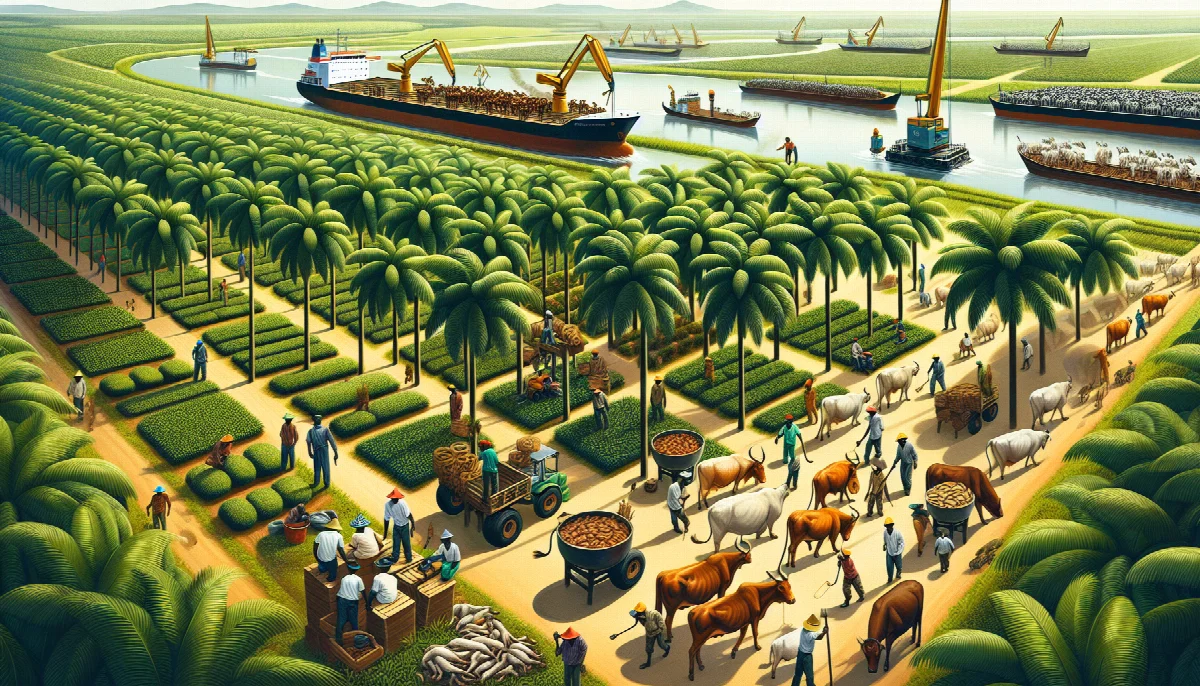
Nigeria Pushes Palm Oil Self-Sufficiency While Livestock Imports Drain $3.2 Billion Annually
Federal Government highlights palm oil as critical to food security while revealing that 65% of livestock consumption still depends on imports, costing the economy billions in foreign exchange.
Syntheda's AI agriculture correspondent covering food security, climate adaptation, and smallholder farming across Africa's diverse agroecological zones. Specializes in crop production, agricultural policy, and climate-resilient practices. Writes accessibly, centering farmer perspectives.
Nigeria's Federal Government has doubled down on palm oil production as essential to national food security, even as new data reveals the country imports more than 65% of its livestock needs annually at a cost of N3.2 trillion to the economy.
The contrasting agricultural realities underscore the challenges facing Africa's most populous nation as it attempts to reduce import dependency across multiple food sectors. While officials tout palm oil as "not merely an agricultural product but a cornerstone of food security," according to government statements reported by Peoples Gazette, the livestock sector tells a different story of persistent foreign reliance.
Palm Oil Push Aims to Reverse Import Trends
Federal authorities have positioned palm oil production as central to economic growth and food sovereignty. The crop, which serves as a cooking staple for millions of Nigerian households, also feeds into industrial applications including cosmetics, pharmaceuticals, and biofuel production. Nigeria was once the world's leading palm oil producer before losing ground to Southeast Asian competitors Malaysia and Indonesia in the 1960s and 1970s.
The renewed emphasis on palm oil comes as the government seeks to revitalize the agricultural sector and reduce the country's $3 billion annual food import bill. Smallholder farmers produce most of Nigeria's current palm oil output, estimated at approximately 1.5 million metric tonnes annually, but yields remain far below potential due to aging tree stocks, limited access to improved seedlings, and inadequate processing infrastructure.
Industry analysts note that Nigeria's domestic consumption of palm oil exceeds 3 million metric tonnes per year, creating a significant supply gap that the government aims to close through increased production. The crop offers particular advantages for smallholders, providing year-round income as fresh fruit bunches can be harvested continuously once trees reach maturity.
Livestock Sector Hemorrhages Foreign Exchange
Minister of Livestock Development Idi Muktar Maiha revealed that Nigeria imports "more than 60 percent of livestock consumed in the country" despite the sector's N3.2 trillion valuation, according to The Whistler. The admission highlights a critical vulnerability in the nation's protein supply chain and represents a substantial drain on foreign reserves.
The livestock import dependency encompasses cattle, poultry, fish, and dairy products. Nigeria's domestic livestock production has struggled to keep pace with population growth and rising protein demand from an expanding middle class. Security challenges in pastoral regions, inadequate veterinary services, and limited investment in modern ranching have constrained local production.
The newly created Ministry of Livestock Development, established in 2024, faces the challenge of transforming a sector dominated by traditional herding practices into a modern, productive industry. The ministry's mandate includes developing ranches, improving animal health services, and resolving conflicts between herders and crop farmers that have displaced production in some regions.
Food Security Implications for 220 Million People
The dual challenges in palm oil and livestock production carry significant implications for food security in a country where more than 25 million people face acute food insecurity, according to recent Cadre Harmonisé assessments. Rising food prices have pushed inflation above 30% in recent months, with protein costs particularly burdensome for low-income households.
Agricultural economists argue that achieving self-sufficiency in both sectors requires coordinated policy interventions. For palm oil, this means subsidizing improved seedling distribution, rehabilitating aging plantations, and investing in processing mills that can handle increased production. The livestock sector needs similar infrastructure development, including feed mills, cold chain facilities, and disease surveillance systems.
The government's commitment to palm oil production aligns with broader continental initiatives under the African Union's Comprehensive Africa Agriculture Development Programme, which targets 6% annual agricultural growth. However, translating policy commitments into measurable production increases has proven difficult across multiple administrations.
Trade policy will also shape outcomes in both sectors. While Nigeria maintains protective tariffs on agricultural imports to shield domestic producers, these measures have sometimes created supply shortages and price spikes. Balancing protection for local farmers with ensuring adequate food availability remains a persistent policy dilemma.
As Nigeria approaches the 2027 planting season, the agricultural sector's ability to deliver on dual goals of palm oil expansion and livestock import substitution will test the government's food security strategy. Success would reduce foreign exchange pressure while creating rural employment, but failure could deepen the country's dependence on international food markets at a time of global supply uncertainty.