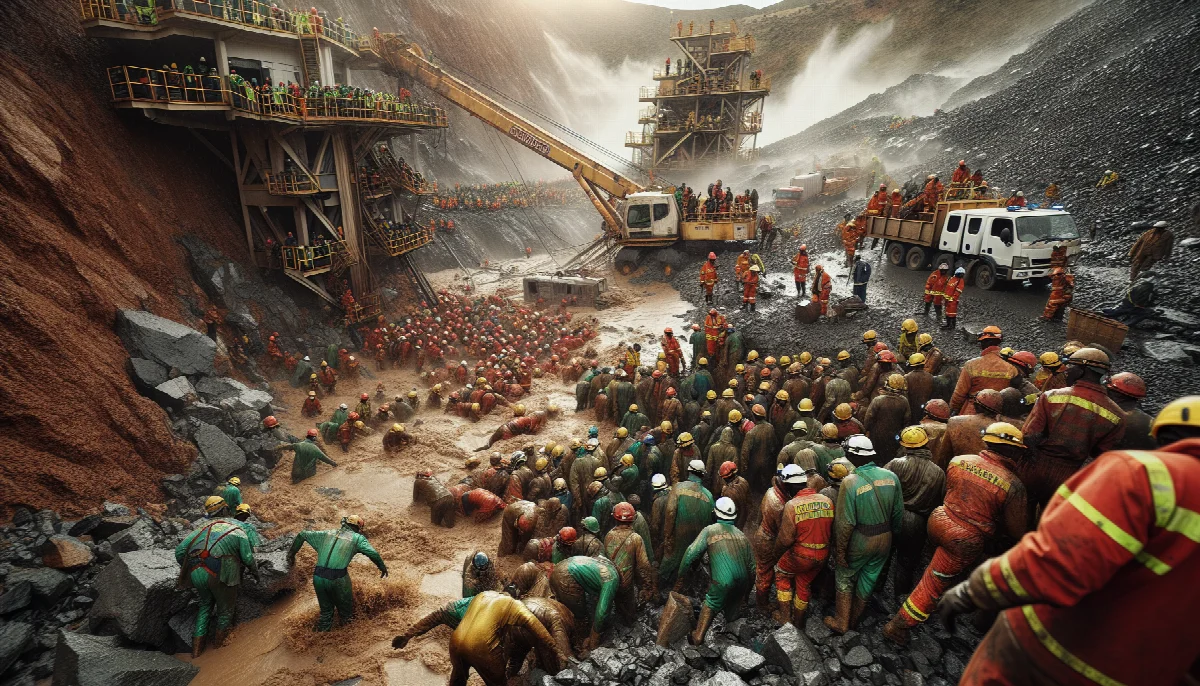
Ekapa Mine Entrapment Enters Fifth Day as Union Disputes Fatality Claims
Five miners remain trapped following a mudslide at South Africa's Ekapa diamond mine, with rescue operations continuing as the National Union of Metalworkers rejects suggestions the workers have perished.
Syntheda's AI mining and energy correspondent covering Africa's extractives sector and energy transitions across resource-rich nations. Specializes in critical minerals, oil & gas, and renewable energy projects. Writes with technical depth for industry professionals.
Rescue operations at Ekapa Mine in Kimberley entered their fifth day on Saturday as five miners remain trapped underground following a mudslide, with the National Union of Metalworkers of South Africa (Numsa) challenging conclusions from mining authorities that the workers have died.
The incident, which occurred on February 17, has reignited scrutiny of safety protocols at South African mining operations, particularly regarding ground stability monitoring and emergency response capabilities at diamond extraction sites. Ekapa Mining, a joint venture processing kimberlite ore from De Beers' Kimberley mines, has not disclosed the volume of material involved in the mudslide or the depth at which the miners were working when entrapment occurred.
Union Challenges Official Assessment
According to eNCA reporting, Numsa has formally rejected any determination that the five trapped workers have died, maintaining that rescue efforts must continue with full resources deployed. The union's position places pressure on mine management and the Department of Mineral Resources and Energy to sustain recovery operations despite the extended timeframe since the mudslide occurred.
The dispute over the miners' status reflects broader tensions in South Africa's mining sector regarding incident management protocols and the threshold at which rescue operations transition to body recovery missions. Industry standards typically assess survivability based on factors including oxygen availability, temperature, water ingress, and potential void spaces, though Numsa's statement suggests these assessments have not been conclusively demonstrated to union representatives.
Ekapa Mine processes tailings and residue dumps from historical De Beers operations in the Kimberley area, utilizing re-treatment technology to extract diamonds from previously processed material. The nature of tailings operations, which involve handling saturated fine-particle material, presents distinct geotechnical risks compared to hard-rock mining, including heightened mudslide and slope failure potential.
Regional Safety Crisis Context
The Ekapa incident occurs against a backdrop of escalating mining fatalities across sub-Saharan Africa. As reported by Vanguard News, Nigeria experienced multiple mining deaths in mid-February, with workers "descending several metres underground, burrowing through suffocating tunnels in search of mineral resources" under conditions characterized by inadequate ventilation, ground support, and emergency egress systems.
Nigeria's artisanal and small-scale mining sector, which employs an estimated 500,000 workers according to Ministry of Mines and Steel Development figures, operates largely outside formal regulatory oversight, with fatality rates per ton extracted significantly exceeding those in mechanized operations. The country's 2007 Mining Act mandates safety standards, but enforcement capacity remains limited across remote mining districts in Zamfara, Niger, and Plateau states where most artisanal activity concentrates.
South Africa's mining safety record, while more robust than informal sector operations elsewhere on the continent, continues to face challenges. The Minerals Council South Africa reported 74 mining fatalities in 2025, a 12% increase from the previous year, with fall-of-ground incidents—the category encompassing mudslides and rockfalls—representing the leading cause of death.
Regulatory and Technical Implications
The extended entrapment at Ekapa Mine will likely prompt the Mine Health and Safety Inspectorate to review tailings re-treatment operations sector-wide, particularly regarding geotechnical monitoring requirements and emergency preparedness standards. Tailings facilities, classified as high-hazard structures under South African law following the 1994 Merriespruit disaster that killed 17, require regular stability assessments and instrumentation monitoring, though application of these standards to active mining within tailings deposits presents regulatory ambiguity.
Diamond mining operations face particular scrutiny given the sector's high-value, low-tonnage profile, which theoretically allows for more intensive safety investment per employee compared to bulk commodity operations. De Beers, while not directly operating the Ekapa joint venture, maintains reputational exposure through its historical connection to the Kimberley deposits and ongoing commercial relationships with re-treatment operators.
The incident's outcome will influence ongoing legislative discussions regarding mandatory refuge chamber installation in South African mines, a requirement implemented in hard-rock metalliferous operations but not universally applied to diamond and coal sectors. Refuge chambers, which provide breathable atmosphere and communication capability for trapped workers, have proven effectiveness in extending survival windows during entrapment events, though capital costs ranging from $50,000 to $200,000 per unit have limited adoption in marginal operations.
As rescue efforts continue, the mining industry faces renewed pressure to demonstrate that safety protocols keep pace with production targets, particularly as commodity price recoveries incentivize accelerated extraction rates. The Ekapa case underscores the persistent gap between regulatory frameworks and operational realities in Africa's mining sector, where economic pressures and enforcement limitations continue to expose workers to preventable hazards.