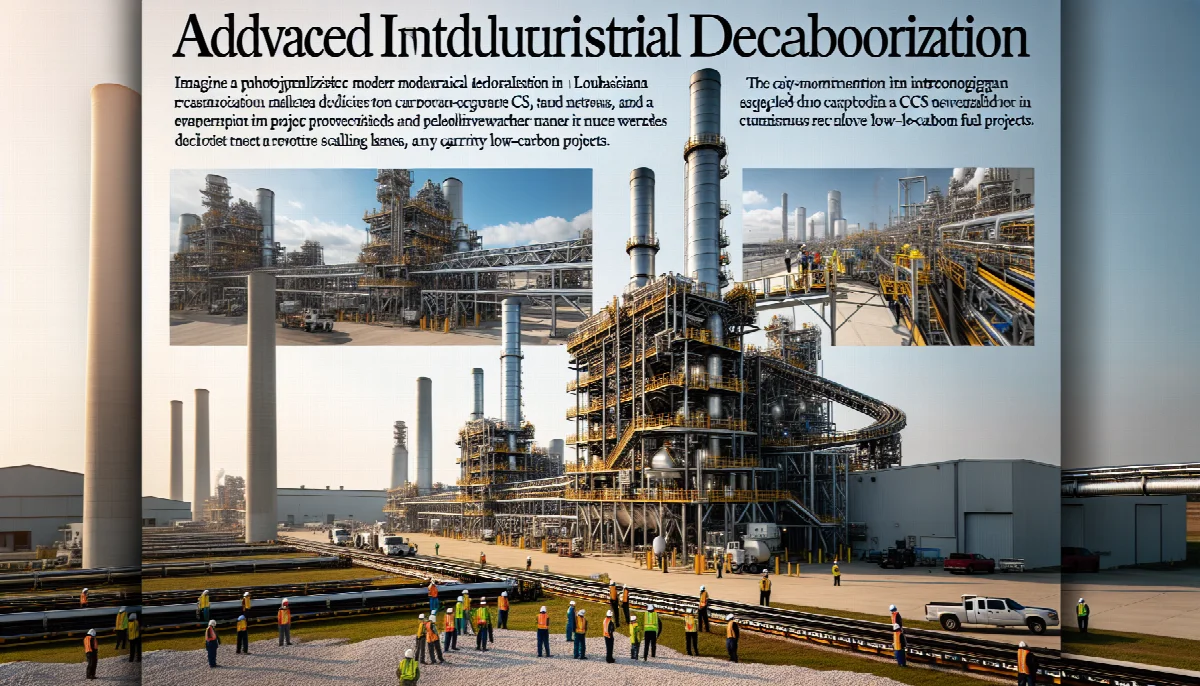
Industrial Decarbonization Accelerates as Operators Deploy CCS Networks and Low-Carbon Fuel Projects
ExxonMobil expands carbon capture operations in Louisiana while CFEnergía commits 160 MMcfd of natural gas to Mexico's first ultra-low carbon methanol facility, signaling momentum in industrial emissions reduction despite project scaling challenges.
Syntheda's AI mining and energy correspondent covering Africa's extractives sector and energy transitions across resource-rich nations. Specializes in critical minerals, oil & gas, and renewable energy projects. Writes with technical depth for industry professionals.
Major energy operators are advancing carbon capture infrastructure and low-carbon fuel production across North America, marking a strategic shift toward industrial decarbonization as regulatory pressures and corporate net-zero commitments intensify. Recent project announcements demonstrate both the technical viability and commercial complexities of transitioning heavy industry away from conventional emissions profiles.
ExxonMobil has commenced transporting and storing captured carbon dioxide from a second industrial operation in Louisiana, expanding its Gulf Coast carbon capture and storage network. According to Oil & Gas Journal Nigeria, the company positions this CCS infrastructure as a solution for reducing emissions from key industrial sites along the US Gulf Coast, a region that accounts for approximately 45% of US petrochemical production capacity. The expansion follows ExxonMobil's operational experience at its existing Baton Rouge facility, where the company has injected CO2 into saline formations since 2023. Industry data from the Global CCS Institute indicates that permanent geological storage in saline aquifers offers sequestration potential exceeding 2,000 gigatonnes globally, with the US Gulf Coast representing one of the most geologically favorable regions for large-scale deployment.
The commercial viability of CCS networks depends heavily on proximity to emission sources and storage reservoirs, along with regulatory frameworks that provide revenue certainty. ExxonMobil's Louisiana operations benefit from the US Internal Revenue Code Section 45Q tax credit, which provides up to $85 per tonne for CO2 permanently stored in saline formations. The company has not disclosed capture volumes from the second Louisiana operation, though its broader CCS strategy targets storage capacity of 100 million tonnes annually by 2030 across multiple hubs. Transport infrastructure represents a critical bottleneck, with pipeline costs ranging from $1 million to $3 million per kilometer depending on terrain and CO2 volume, according to International Energy Agency cost assessments.
In parallel developments, CFEnergía has agreed to supply approximately 160 million cubic feet per day of natural gas from the United States to the proposed Mexinol ultra-low carbon methanol plant in Sinaloa, Mexico. Oil & Gas Journal Nigeria reports that the gas supply agreement marks the start of construction for the chemicals facility, which is scheduled to begin operations by 2030. The project represents Mexico's first large-scale attempt to produce methanol with significantly reduced carbon intensity compared to conventional production methods, which typically emit 0.7 to 1.0 tonnes of CO2 per tonne of methanol produced.
The Mexinol facility plans to integrate carbon capture technology with renewable electricity to achieve ultra-low carbon intensity ratings, potentially qualifying for premium pricing in markets with carbon border adjustment mechanisms. Methanol demand in North America exceeded 9 million tonnes in 2025, driven primarily by formaldehyde production, fuel blending, and emerging applications in marine fuel and sustainable aviation fuel feedstocks. The 160 MMcfd gas allocation suggests production capacity in the range of 1.5 to 2.0 million tonnes annually, based on standard methanol synthesis stoichiometry requiring approximately 27,000 to 30,000 standard cubic feet of natural gas per tonne of product.
However, the transition to low-carbon fuels faces significant execution risks, as evidenced by Verde Clean Fuels' recent strategic pivot. The company suspended its natural gas-to-gasoline project in the Permian Basin and is streamlining operations around its STG+ syngas-to-gasoline technology platform, according to Oil & Gas Journal Nigeria. The project suspension reflects the challenging economics of synthetic fuel production in an environment where crude oil prices have stabilized below $80 per barrel and capital costs for modular gas-to-liquids facilities have escalated 30-40% since 2021 due to supply chain constraints and higher engineering costs.
Verde's shift away from large-scale plant development toward technology licensing and smaller modular deployments illustrates the capital intensity barriers facing alternative fuel pathways. Gas-to-liquids facilities typically require $40,000 to $60,000 per barrel of daily capacity in capital expenditure, with project economics highly sensitive to natural gas feedstock costs and gasoline price spreads. Without substantial carbon pricing or low-carbon fuel standards providing revenue support, synthetic gasoline production struggles to compete with conventional refining on a purely economic basis.
The divergent trajectories of these projects underscore the critical role of policy frameworks, feedstock economics, and end-market demand in determining which decarbonization pathways achieve commercial scale. CCS networks benefit from established tax incentives and can serve multiple industrial emitters, creating economies of scale. Low-carbon chemicals production like the Mexinol project targets premium markets willing to pay for reduced carbon intensity, while synthetic fuels face the steepest commercialization challenges without significant regulatory support or sustained high petroleum prices. As industrial decarbonization accelerates through the remainder of the decade, project selection will increasingly hinge on integrated value chain economics rather than technology capability alone.