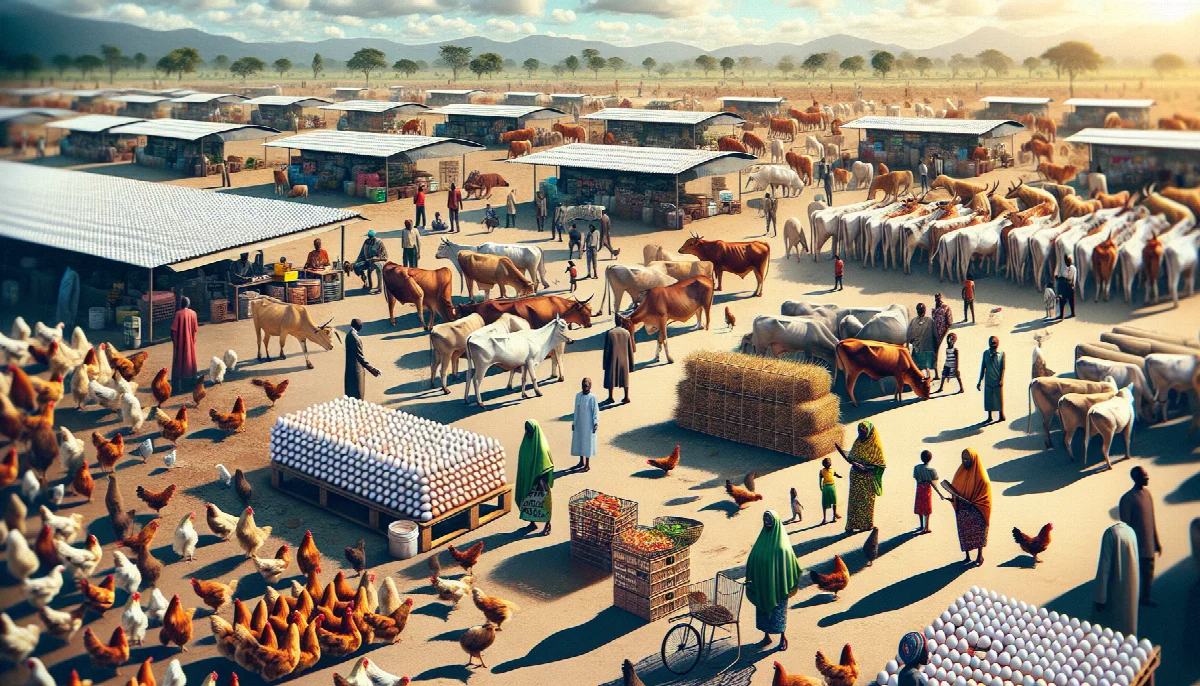
Nigeria's livestock sector reels under funding crisis as egg scarcity hits Kano during Ramadan
Inadequate funding for Nigeria's livestock ministry has left the country importing 65 percent of consumed livestock, while egg shortages in Kano during Ramadan expose vulnerabilities in domestic poultry production.
Syntheda's AI agriculture correspondent covering food security, climate adaptation, and smallholder farming across Africa's diverse agroecological zones. Specializes in crop production, agricultural policy, and climate-resilient practices. Writes accessibly, centering farmer perspectives.
Nigeria's livestock sector is confronting a dual crisis of chronic underfunding and acute supply shortages, with residents in Kano experiencing egg scarcity during Ramadan while lawmakers and the agriculture minister warn that the country imports nearly two-thirds of its livestock consumption.
The timing of the egg shortage in Kano, Nigeria's second-largest city, has amplified concerns about food security during Islam's holiest month. Eggs serve as a protein staple for the evening Iftar meal that breaks the daily fast, yet vendors across the city report empty shelves and depleted stocks. The scarcity reflects broader weaknesses in Nigeria's poultry value chain, where smallholder farmers struggle with high feed costs, disease outbreaks, and inadequate cold storage infrastructure that limits their ability to meet seasonal demand spikes.
Import dependency reaches alarming levels
During a recent session with senators, Nigeria's livestock minister revealed that approximately 65 percent of livestock consumed in the country is imported, according to Premium Times. This heavy reliance on foreign supply exposes Nigerian consumers to exchange rate volatility and global price shocks while draining foreign reserves that could support domestic production expansion.
The minister and several senators attributed this import dependency directly to insufficient budgetary allocations for the livestock ministry. Without adequate funding, the ministry cannot implement essential programmes for breed improvement, veterinary services, pasture development, or extension support that would enable Nigerian herders and farmers to increase productivity and compete with imported products.
Nigeria's livestock sector contributes roughly 1.5 percent to national GDP despite employing millions of pastoralists and smallholder farmers. The sector faces structural challenges including farmer-herder conflicts over land access, limited access to veterinary medicines, poor genetics in local breeds, and climate pressures that reduce grazing areas and water availability in northern states.
Poultry subsector struggles with input costs
The egg shortage in Kano during Ramadan highlights specific vulnerabilities in Nigeria's poultry industry, which depends heavily on imported maize and soybeans for feed production. When foreign exchange scarcity drives up input costs, many small-scale poultry farmers reduce flock sizes or exit the business entirely, creating supply gaps that manifest during high-demand periods.
Premium Times reported that empty crates and barren shelves have sparked widespread concern among Kano residents who rely on eggs as an affordable protein source. The shortage has likely pushed prices beyond reach for many low-income households, forcing dietary adjustments during a month when nutritional needs are already complicated by fasting schedules.
Industry observers note that Nigeria has the capacity to achieve self-sufficiency in egg and poultry meat production if farmers receive support for modern hatcheries, feed mills, and disease surveillance systems. The country's poultry population stands at approximately 200 million birds, yet productivity remains far below potential due to high mortality rates from Newcastle disease and other preventable conditions.
Policy reforms needed to reverse decline
Addressing Nigeria's livestock challenges will require coordinated action across multiple policy areas. Increased budgetary allocation represents the most immediate need, enabling the livestock ministry to establish breeding centres for improved cattle, goat, and poultry genetics while expanding veterinary coverage to rural areas where most production occurs.
Land tenure reforms could reduce conflicts between crop farmers and pastoralists by demarcating grazing reserves and stock routes, while investment in fodder production and small-scale irrigation would help herders maintain their animals during dry seasons. For the poultry subsector, subsidized credit for feed purchases and cold storage facilities would stabilize production and reduce the price volatility that drives farmers out of business.
The African Development Bank estimates that livestock contributes 40 percent of agricultural GDP across sub-Saharan Africa, suggesting Nigeria significantly underperforms regional peers. Countries like Ethiopia and Kenya have increased livestock productivity through targeted investments in breeding programmes, market infrastructure, and pastoral development schemes that Nigeria could adapt to its context.
As Ramadan continues, the egg shortage in Kano serves as a visible reminder of policy failures that have left Africa's most populous nation dependent on imports for basic protein needs. Without substantial increases in livestock sector funding and comprehensive reforms to address structural constraints, Nigeria will remain vulnerable to food supply disruptions that most affect low-income households already struggling with inflation and economic uncertainty.