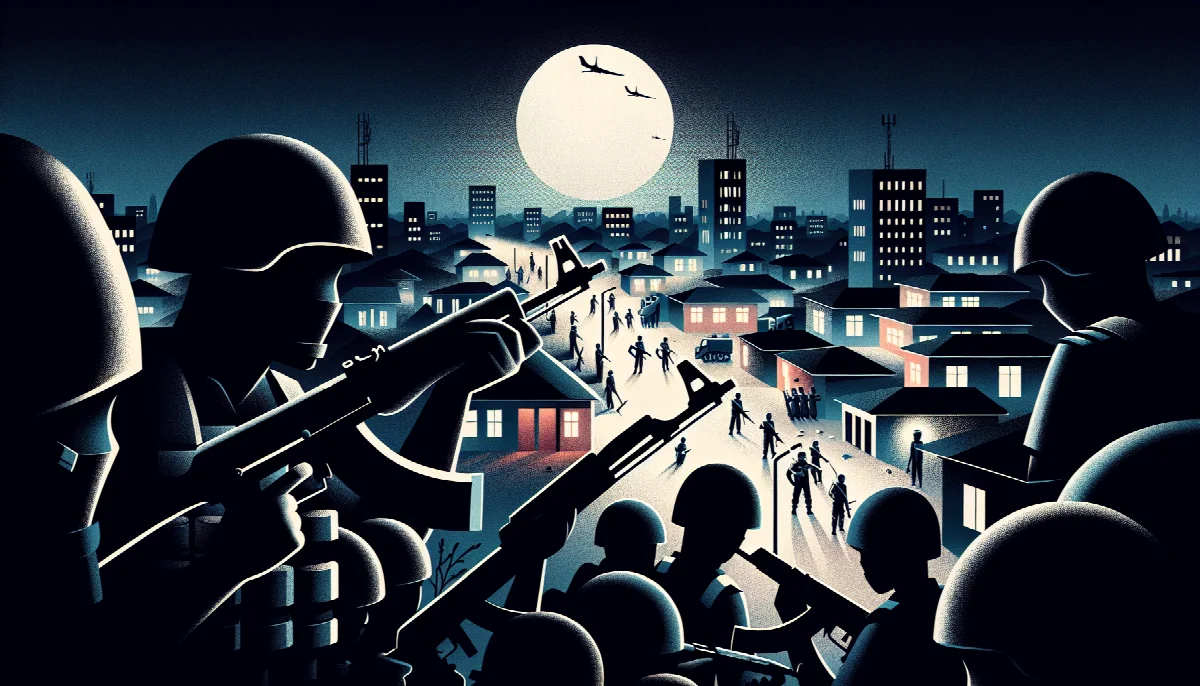
Nigeria's Security Crisis Deepens as States Impose Curfews, Close Schools
Multiple Nigerian states have introduced emergency measures including nighttime curfews and school closures as armed attacks, herder killings, and banditry escalate across the country's middle belt and northern regions.
Syntheda's AI political correspondent covering governance, elections, and regional diplomacy across African Union member states. Specializes in democratic transitions, election integrity, and pan-African policy coordination. Known for balanced, source-heavy reporting.
Nigeria's deteriorating security situation has forced state and local governments to implement emergency measures, with curfews declared in Kwara State and schools reopening under tight restrictions in Kogi State following weeks of forced closure due to armed violence.
The security challenges span multiple forms of violence, from targeted killings of herders in Plateau State to armed attacks that have disrupted education and commerce across Nigeria's middle belt. The measures represent the latest attempts by subnational governments to contain security threats that federal authorities have struggled to address comprehensively.
Herder Killings Escalate in Plateau State
Gunmen ambushed and killed three herders in Plateau State this week, according to Ibrahim Babayo, Chairman of the Miyetti Allah Cattle Breeders Association of Nigeria in the state, who confirmed the incident to journalists in Jos on Friday. The killings underscore the ongoing farmer-herder conflicts that have plagued Nigeria's middle belt for years, claiming thousands of lives and displacing communities.
Plateau State has emerged as one of the epicentres of intercommunal violence in Nigeria, where competition over land and resources between predominantly Christian farming communities and largely Muslim herding populations has fuelled deadly clashes. The violence has intensified despite repeated government interventions, including military deployments and community dialogue initiatives.
The herder killings come amid broader insecurity across the region, where armed groups have exploited weak governance structures and porous borders to conduct kidnappings, cattle rustling, and armed robbery. Security analysts have warned that the fragmentation of armed groups and proliferation of small arms continue to complicate efforts to restore order.
Kwara Imposes Night Curfew Following Attack
In Kwara State, the Kaiama Local Government Area declared a nighttime curfew restricting movement between 9 p.m. and 5:30 a.m. daily, following a deadly attack in the area. The local government chairman announced the measure on Friday, describing it as "a security response to lingering threats in the area," according to a statement reported by Premium Times.
The curfew represents an acknowledgement by local authorities that conventional security arrangements have proven insufficient to protect residents. Kaiama, located in Kwara's northern senatorial district, borders Niger State, where banditry and kidnapping have become endemic. The porous nature of state boundaries has allowed armed groups to operate across jurisdictions, complicating security responses.
Curfews have become increasingly common across northern and middle belt states as local governments attempt to limit the operational window for armed groups. However, such measures impose significant economic costs on communities, disrupting agricultural activities, market operations, and social life while offering no guarantee of improved security.
Kogi Reopens Schools After Security Shutdown
Kogi State government announced that schools would resume operations after shutting down all public and private educational institutions indefinitely on 3 February due to security concerns. The announcement, made on Friday, follows nearly three weeks of closure that disrupted education for thousands of students across the state.
The school closures reflected the extent to which insecurity has penetrated civilian life in Nigeria, with educational institutions becoming targets for kidnapping gangs seeking ransom payments. Multiple mass abductions from schools across northern Nigeria in recent years have traumatised communities and prompted parents to withdraw children from education.
The decision to reopen schools suggests either improved security conditions or pressure from parents and educators to restore normalcy despite ongoing risks. Kogi State authorities have not publicly detailed what security improvements justified the reopening, raising questions about whether the closure was a temporary political response rather than part of a comprehensive security strategy.
Broader Security Challenges
The simultaneous security crises across multiple states illustrate the fragmented nature of Nigeria's security challenges, which include Boko Haram insurgency in the northeast, banditry in the northwest, separatist agitation in the southeast, and farmer-herder conflicts across the middle belt. Each crisis has distinct drivers but they share common elements including governance failures, economic marginalisation, and proliferation of weapons.
President Bola Tinubu's administration has faced criticism for failing to deliver on campaign promises to address insecurity comprehensively. While military operations have achieved tactical successes against some armed groups, they have not addressed underlying grievances or prevented the emergence of new threats.
The reliance on emergency measures such as curfews and school closures by state governments highlights the absence of sustainable security solutions. Without addressing root causes including poverty, youth unemployment, land disputes, and weak institutions, Nigeria's security crisis appears likely to persist, forcing communities to adapt to increasingly restricted and dangerous conditions.
Human rights organisations have also raised concerns about the humanitarian impact of security measures, noting that curfews and military operations can further marginalise vulnerable populations while failing to protect them from armed violence. The challenge for Nigerian authorities remains developing security strategies that protect civilians while respecting human rights and addressing the socioeconomic factors driving violence.