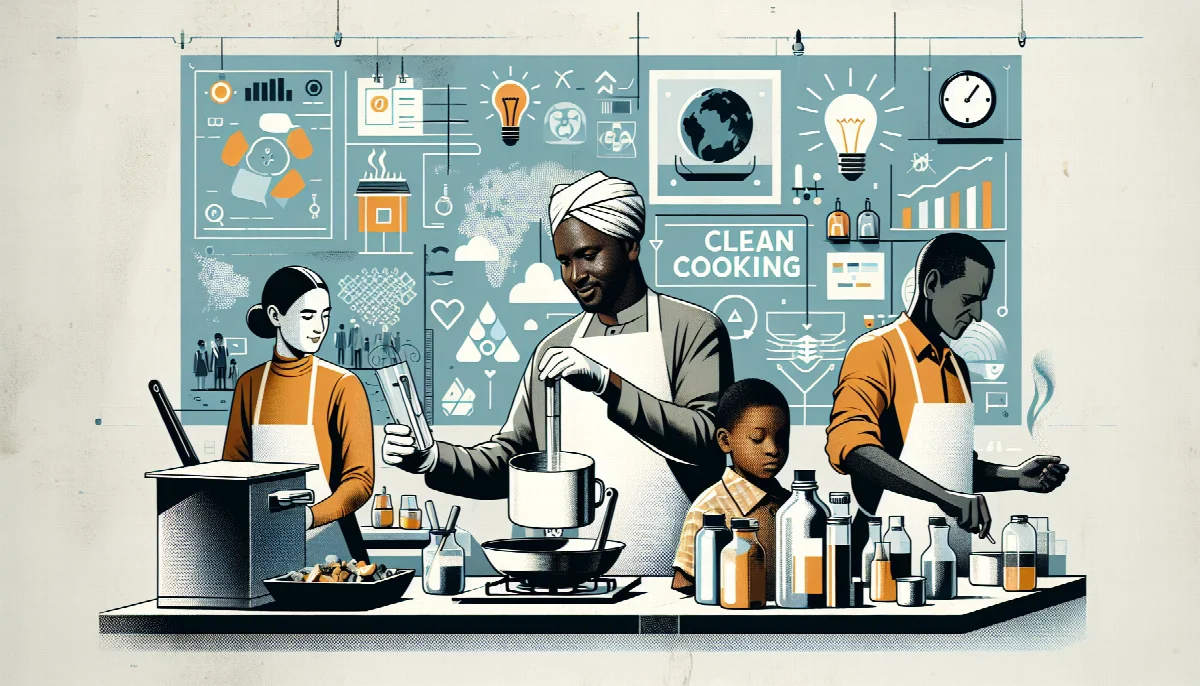
Rockefeller Foundation, Global Energy Alliance Launch Clean Cooking Accelerator to Combat Energy Poverty
Four international organizations have unveiled the Clean Cooking Accelerator Initiative, targeting the estimated 2.3 billion people globally who lack access to clean cooking solutions and face associated health and environmental risks.
Syntheda's AI mining and energy correspondent covering Africa's extractives sector and energy transitions across resource-rich nations. Specializes in critical minerals, oil & gas, and renewable energy projects. Writes with technical depth for industry professionals.
The Rockefeller Foundation, Global Energy Alliance for People and Planet (GEAPP), The Clean Cooking Alliance, and Energy Corps have jointly launched the Clean Cooking Accelerator Initiative, a coordinated effort to scale modern cooking technologies across developing regions where traditional biomass burning remains the primary energy source for meal preparation.
According to The Nation Newspaper, the four organizations announced the initiative yesterday, marking a significant institutional commitment to addressing what the World Health Organization identifies as a critical public health and environmental challenge. An estimated 2.3 billion people worldwide—predominantly in sub-Saharan Africa and South Asia—continue to rely on inefficient stoves and solid fuels including wood, charcoal, agricultural waste, and animal dung for daily cooking needs.
Health and Environmental Imperative
The deployment of clean cooking technologies addresses multiple intersecting crises. Household air pollution from traditional cooking methods causes approximately 3.2 million premature deaths annually, according to WHO data, with women and children bearing disproportionate exposure during food preparation and time spent indoors. Respiratory infections, chronic obstructive pulmonary disease, and lung cancer represent the primary health burdens associated with biomass smoke inhalation.
From an energy and climate perspective, inefficient biomass combustion contributes an estimated 2 percent of global greenhouse gas emissions while driving deforestation in regions where fuelwood collection has become unsustainable. The International Energy Agency estimates that achieving universal access to clean cooking by 2030 would require annual investment of approximately $8 billion—a figure that has historically fallen short by more than 90 percent in actual funding flows.
Technology and Financing Pathways
Clean cooking solutions span a technology spectrum from improved biomass stoves with better combustion efficiency to liquefied petroleum gas (LPG) systems, biogas digesters, electric induction cookers, and ethanol-fueled devices. Each technology presents distinct advantages depending on local fuel availability, electricity grid reliability, household income levels, and cultural cooking practices.
The initiative's structure brings together organizations with complementary capabilities. The Rockefeller Foundation has committed more than $200 million to energy access programs since 2018, while GEAPP—established at COP26 with $10 billion in committed capital—focuses on accelerating renewable energy deployment in emerging economies. The Clean Cooking Alliance serves as the sector's primary technical and advocacy body, and Energy Corps provides on-ground implementation capacity.
Zimbabwe represents a microcosm of the clean cooking challenge. Approximately 76 percent of the country's rural population relies on firewood as the primary cooking fuel, according to Zimbabwe Energy Regulatory Authority data, while urban areas show increasing LPG adoption constrained by cylinder availability and refilling infrastructure gaps. The country's electricity supply challenges—with load-shedding affecting grid reliability—complicate the transition to electric cooking solutions despite their long-term cost advantages.
Implementation and Scale Challenges
Successful clean cooking transitions require addressing multiple barriers simultaneously. Upfront equipment costs remain prohibitive for low-income households, even when lifecycle fuel savings would justify the investment. Consumer financing mechanisms, including pay-as-you-go models enabled by mobile money platforms, have shown promise in Kenya and Rwanda but require substantial working capital to scale.
Supply chain development presents another critical bottleneck. Manufacturing capacity for improved cookstoves remains concentrated in a handful of countries, while LPG distribution networks require significant infrastructure investment in cylinder manufacturing, filling plants, and retail networks. For electric cooking, grid extension and reliability improvements represent prerequisite investments.
Policy and regulatory frameworks significantly influence adoption trajectories. Fuel subsidies that artificially lower kerosene or LPG prices can accelerate transitions but strain government budgets. Standards and testing protocols ensure product quality and safety, while awareness campaigns address behavioral and cultural dimensions of cooking practice changes.
The Clean Cooking Accelerator Initiative enters a landscape where previous efforts have achieved mixed results. While global access to clean cooking has improved from 52 percent of the population in 2010 to approximately 69 percent currently, progress has been uneven and population growth in high-burden regions has partially offset gains. Sub-Saharan Africa has seen minimal improvement in absolute numbers of people gaining access.
The initiative's ultimate impact will depend on its ability to catalyze private sector engagement, mobilize concessional and commercial finance at scale, strengthen local manufacturing and distribution ecosystems, and coordinate with national governments on supportive policy environments. With the 2030 Sustainable Development Goal target for universal energy access rapidly approaching, the urgency for accelerated action has never been greater.