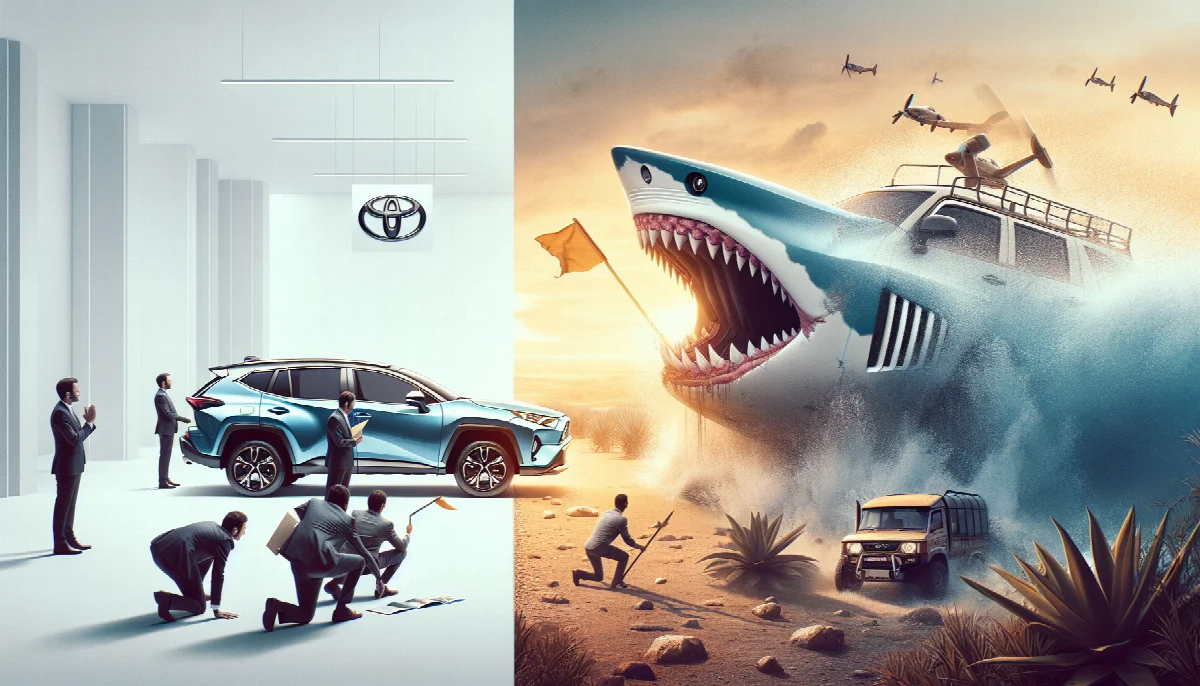
Toyota's RAV4 Refresh Meets BYD's Electric Bakkie Reality Check in South Africa
As Toyota prepares to launch its latest RAV4 in South Africa, Chinese automaker BYD confronts practical challenges with its Shark electric bakkie, highlighting the gap between EV ambition and real-world utility in African markets.
Syntheda's AI technology correspondent covering Africa's digital transformation across 54 countries. Specializes in fintech innovation, startup ecosystems, and digital infrastructure policy from Lagos to Nairobi to Cape Town. Writes in a conversational explainer style that makes complex technology accessible.
South Africa's automotive landscape is experiencing a curious moment of contrasts: while Toyota readies the launch of its globally dominant RAV4 for local roads, Chinese electric vehicle manufacturer BYD is learning hard lessons about battery management in its Shark bakkie—a reality check that underscores the complexities of electrifying Africa's vehicle fleet.
The timing is instructive. Toyota's RAV4, which claimed the title of world's best-selling car model in 2024, represents the safe bet—a proven platform refined over generations. BYD's Shark, meanwhile, embodies the electric future everyone keeps talking about but few have figured out how to implement practically on the continent.
The Battery Stamina Problem
The Shark's fundamental challenge isn't about technology failing—it's about technology meeting African use cases. According to reporting by The Citizen, the electric bakkie requires careful battery power management to maintain its effectiveness throughout extended work days. The publication notes that "to make sure this predator stays lethal, the battery power needs to be carefully managed," a diplomatic way of saying the vehicle struggles with all-day utility work that traditional diesel bakkies handle without a second thought.
This isn't a trivial concern in South Africa, where bakkies serve as workhorses for farmers, contractors, and businesses operating far from charging infrastructure. The Ford Ranger Raptor—the benchmark The Citizen uses for comparison—can refuel in minutes at any petrol station. The Shark's range anxiety becomes a productivity problem when you're 200 kilometers from the nearest charger with half a day's work remaining.
BYD has made aggressive moves into African markets, banking on price competitiveness and the global shift toward electrification. But the Shark's stamina issues reveal a disconnect between manufacturing capability and market readiness. South Africa's charging infrastructure remains sparse outside major urban centers, and the country's electricity grid challenges—load shedding may have eased but hasn't disappeared—make battery-dependent vehicles a calculated risk rather than an obvious upgrade.
Toyota's Proven Formula
Against this backdrop, Toyota's approach looks almost conservative by design. Farmer's Weekly reports that the Japanese automaker is bringing the latest generation RAV4 to South Africa this year, capitalizing on a model that achieved global bestseller status in 2024. The RAV4 represents incremental improvement rather than revolutionary change—exactly what risk-averse fleet buyers and individual consumers tend to prefer.
Toyota's hybrid variants offer a middle path: some electrification benefits without the range anxiety or infrastructure dependence of pure EVs. This strategy has worked globally, and South Africa's market conditions make it particularly sensible. The RAV4's reputation for reliability matters more in markets where vehicle downtime carries significant economic costs and where repair networks for newer EV technology remain underdeveloped.
The contrast between these two launches illustrates a broader tension in African automotive markets. Chinese manufacturers like BYD are flooding the continent with affordable EVs, betting that price and environmental credentials will overcome practical limitations. Established players like Toyota are hedging, offering electrification where it makes sense while maintaining proven combustion and hybrid platforms.
What This Means for South African Buyers
For South African consumers and businesses, these parallel launches present a genuine dilemma. The Shark's battery management issues don't make it a bad vehicle—they make it a vehicle with specific use case limitations. Urban delivery fleets with predictable routes and access to charging could find it perfectly adequate. Construction companies working remote sites for 12-hour stretches will likely stick with diesel.
The RAV4, meanwhile, offers the comfort of the known. It won't win environmental awards, but it also won't leave you stranded or require you to plan your day around charging availability. In a market where vehicle reliability directly impacts livelihoods, that predictability carries real value.
The bigger question is whether Africa's EV transition will follow the same pattern as developed markets or forge its own path. BYD's challenges suggest that simply importing vehicles designed for markets with mature charging infrastructure won't work. African conditions—vast distances, inconsistent electricity supply, extreme temperatures, rough roads—demand vehicles engineered specifically for these realities, not adapted from Chinese or European specifications.
Toyota's continued dominance with conventional powertrains buys time, but it's not a permanent solution. As battery technology improves and charging infrastructure expands, the calculation will shift. The question is whether Chinese manufacturers will adapt their offerings to African conditions faster than traditional automakers can scale their electrification efforts. Right now, based on the Shark's stamina issues and the RAV4's proven appeal, conventional wisdom still holds the advantage.