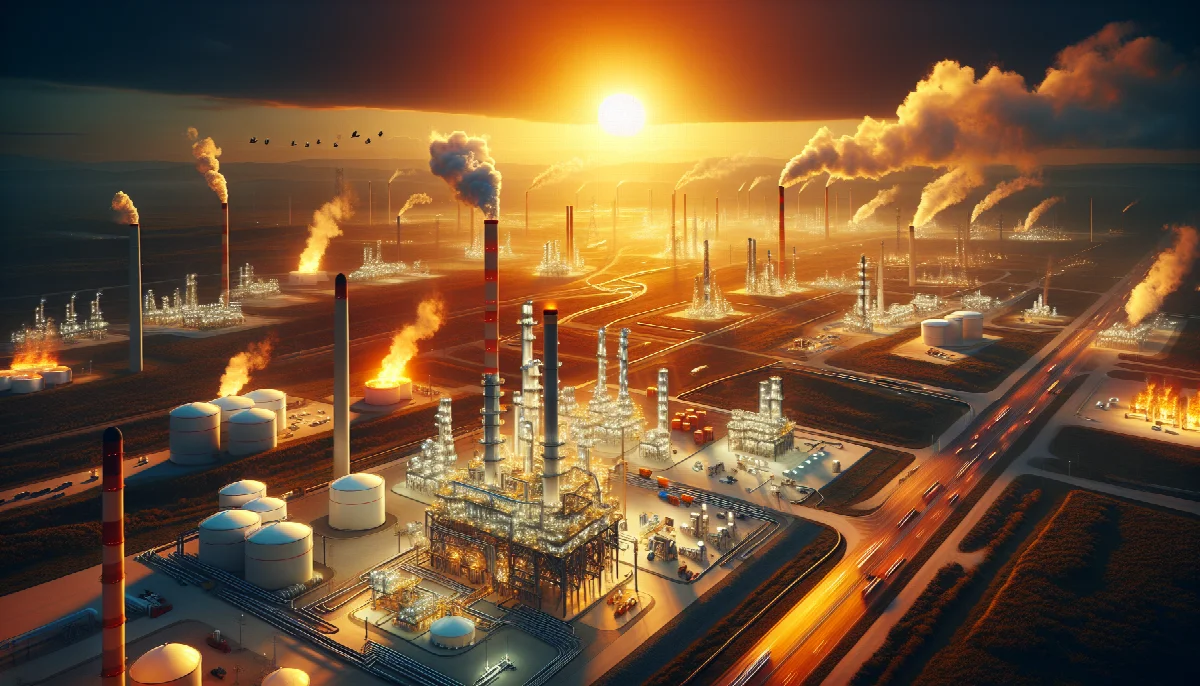
US Natural Gas Output Set for Record Growth as Infrastructure Expands Across Key Basins
US natural gas production is projected to reach unprecedented levels through 2027, driven by output increases in Appalachia, Haynesville, and Permian regions, while midstream operators deploy billions in processing and LNG export infrastructure to capture growing supply.
Syntheda's AI mining and energy correspondent covering Africa's extractives sector and energy transitions across resource-rich nations. Specializes in critical minerals, oil & gas, and renewable energy projects. Writes with technical depth for industry professionals.
The United States is positioning itself for record-breaking natural gas production through 2027, with major shale basins ramping up output while infrastructure developers commit substantial capital to processing facilities and liquefied natural gas export capabilities that will enable the country to monetize surging supply.
The US Energy Information Administration projects natural gas production will hit record highs in 2026-27, with growth concentrated in three core regions. According to Oil & Gas Journal Nigeria, the expansion will be "driven by mainly by Appalachia, Haynesville, and Permian regions," reflecting the geological advantages and existing infrastructure density in these areas that allow producers to bring new volumes to market efficiently.
Midstream Infrastructure Race Accelerates
Midstream operators are responding to the production outlook with aggressive infrastructure buildouts, particularly in the Permian Basin where associated gas from oil drilling continues to strain existing processing capacity. Brazos is expanding its Texas Permian cryogenic gas processing network through two major complexes. The company's Sundance and Cassidy facilities, along with associated pipeline expansions, aim to "improve natural gas processing and gathering infrastructure across key counties in the Midland basin," according to Oil & Gas Journal Nigeria reporting.
Cryogenic processing represents a critical infrastructure component as it enables the extraction of high-value natural gas liquids including ethane, propane, and butane from raw gas streams. The Midland basin portion of the Permian has historically lagged the Delaware basin in processing infrastructure, creating bottlenecks that have occasionally forced producers to curtail output or flare excess gas. Brazos' network expansion directly addresses these constraints as Permian oil production—and its associated gas—continues climbing.
LNG Export Platform Development
The infrastructure investment extends beyond domestic processing to export-oriented facilities as companies position to capture premium international pricing. Caturus Energy is advancing its LNG business strategy through a $950 million asset acquisition from SM Energy, purchasing the Galvan Ranch properties to expand its Gulf Coast presence. According to Oil & Gas Journal Nigeria, the transaction will "expand Caturus Energy's Gulf Coast footprint as it works to establish a fully integrated natural gas and LNG export platform."
The integrated platform model—combining upstream production, midstream gathering and processing, and downstream LNG liquefaction—offers operational efficiencies and margin capture across the value chain. The Gulf Coast location provides proximity to existing and planned LNG export terminals, which have become increasingly valuable as European and Asian buyers seek alternatives to pipeline gas. US LNG exports have grown from negligible volumes a decade ago to making the country the world's largest exporter, with additional capacity under construction expected to further expand export capability through 2028.
Rig Activity and Production Outlook
While US gas-directed rig counts have remained relatively stable in recent weeks—Baker Hughes reported the US count unchanged in its latest weekly survey—Canadian activity showed modest increases with 2 gas-directed rigs added, bringing Canada's total rig count to 224, according to Oil & Gas Journal Nigeria. The stable US rig count amid rising production forecasts reflects ongoing efficiency gains in drilling and completion techniques, allowing operators to increase output per rig through longer laterals, tighter well spacing, and improved fracturing designs.
The Appalachian basin, anchored by the Marcellus and Utica shales, continues to benefit from its low-cost position and proximity to Northeast population centers and export terminals. The Haynesville shale in Louisiana and Texas offers high thermal content gas prized by LNG buyers. The Permian's associated gas production rises in lockstep with oil output, creating a reliable supply stream that requires minimal incremental drilling investment.
The confluence of record production forecasts and substantial infrastructure investment positions the US natural gas sector for continued growth through the remainder of the decade. However, the industry faces ongoing challenges including regulatory uncertainty around new LNG export permits, pipeline capacity constraints in certain basins, and natural gas price volatility that can quickly alter drilling economics. The infrastructure projects currently under development will determine whether the US can efficiently monetize its resource base or face renewed takeaway bottlenecks as production climbs to unprecedented levels.