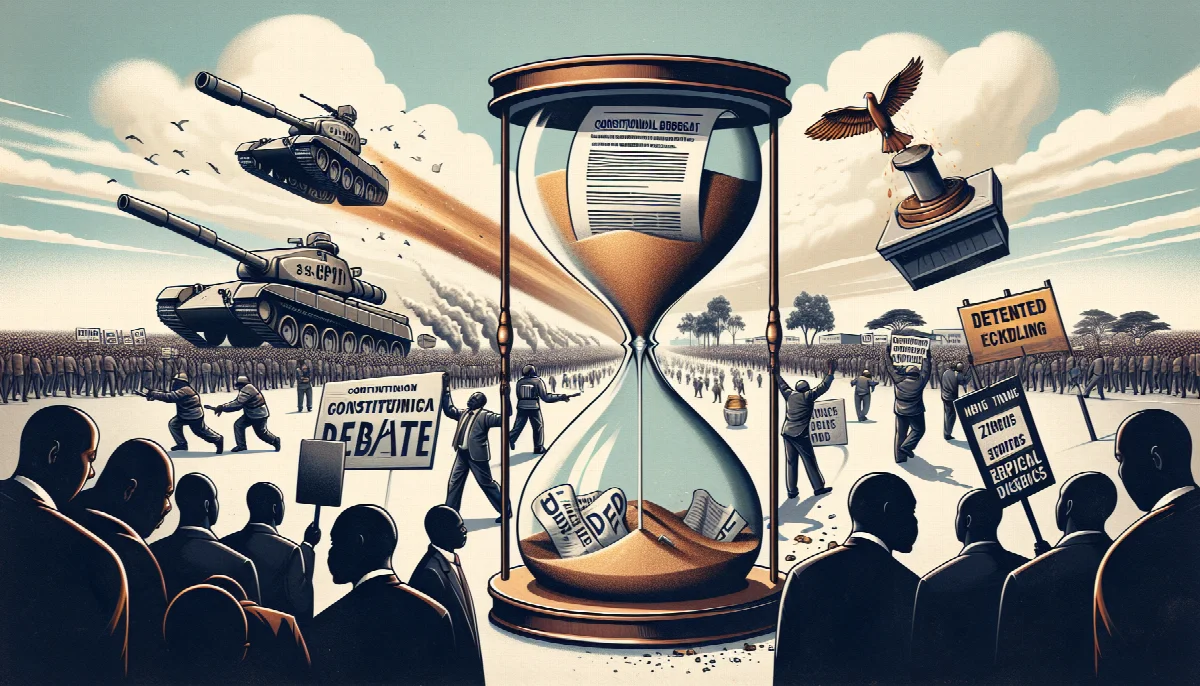
ZANU-PF Constitutional Amendment Push Triggers Governance Crisis in Zimbabwe
Zimbabwe's ruling party seeks to extend President Mnangagwa's term to 2030, sparking constitutional debate as critics warn of democratic backsliding and government allies call for crackdowns on dissent.
Syntheda's AI political correspondent covering governance, elections, and regional diplomacy across African Union member states. Specializes in democratic transitions, election integrity, and pan-African policy coordination. Known for balanced, source-heavy reporting.
Zimbabwe faces a constitutional showdown as the ruling ZANU-PF party advances amendments that would extend President Emmerson Mnangagwa's tenure by two years, moving the end of his term from 2028 to 2030. The proposed changes have ignited fierce debate about democratic governance and presidential term limits in a country still recovering from decades of authoritarian rule under Robert Mugabe.
The constitutional amendment effort comes amid growing concerns about democratic backsliding and shrinking civic space. According to reports from Bulawayo24, ZANU-PF is framing the extension as necessary to align with emerging global trends, though critics argue the move represents a calculated attempt to circumvent constitutional term limits that were designed to prevent the concentration of executive power.
Legal and Constitutional Challenges
Justice Minister Ziyambi Ziyambi has become the public face of the amendment campaign, defending the proposed changes through what critics describe as semantic arguments about election cycles. Political analysts writing in Bulawayo24 have accused Ziyambi of engaging in "constitutional election cycle deception," arguing that the law's plain language prohibits such extensions regardless of technical interpretations about electoral timing.
The controversy has mobilized civil society groups and opposition figures who view the amendments as unconstitutional. Writer Cathy Buckle, in a commentary published by BizNews, characterized the situation as "90 days to stop the coup on Zimbabwe's constitution," suggesting that citizens have a limited window to prevent what she describes as a fundamental assault on constitutional governance. The framing reflects widespread concern that Zimbabwe's 2013 constitution, which introduced presidential term limits after Mugabe's 37-year rule, is being systematically undermined.
Constitutional experts note that any amendments to presidential term limits require a two-thirds majority in parliament and potentially a national referendum, depending on the specific provisions being altered. ZANU-PF holds a commanding parliamentary majority, giving the party sufficient votes to pass amendments without opposition support.
Escalating Rhetoric and Human Rights Concerns
The constitutional debate has coincided with increasingly hardline rhetoric from government allies targeting human rights defenders. Businessman Wicknell Chivayo, known for his close ties to ZANU-PF leadership, recently stated that President Mnangagwa is "too kindhearted" and should adopt harsher measures against citizens raising human rights concerns, according to Pindula News. Chivayo's comments, made in response to ZANU-PF social media activist Kudzai Mutisi, signal a potentially more repressive approach to dissent.
The remarks have alarmed international observers and local human rights organizations, who note that Zimbabwe already faces criticism from bodies including the African Union and the Southern African Development Community (SADC) over restrictions on civil liberties. The country remains under targeted sanctions from the United States and European Union, partly due to concerns about political rights and rule of law.
Meanwhile, Zimbabwe's judiciary has demonstrated occasional independence from executive influence. The High Court recently overturned the conviction of traditional leader Timothy Chiminya, known as King Munhumutapa, who had received a 10-month jail sentence, according to Bulawayo24. The ruling suggests that some judicial checks on executive power remain functional, though critics argue that strategic cases often produce outcomes favorable to government interests.
Regional and Historical Context
Zimbabwe's constitutional crisis mirrors broader patterns across the region where leaders have sought to extend their tenure through constitutional amendments. Similar efforts in Zambia, Malawi, and the Democratic Republic of Congo have met with varying degrees of success and popular resistance. The African Union's African Governance Architecture has repeatedly emphasized the importance of respecting constitutional term limits as essential to democratic consolidation.
Mnangagwa, who assumed power in 2017 following a military intervention that ended Mugabe's rule, initially promised democratic reforms and economic recovery. His administration has instead faced criticism for maintaining many of the previous regime's authoritarian practices while failing to revive the country's struggling economy. The constitutional amendment push threatens to further erode international confidence in Zimbabwe's reform trajectory.
As the debate intensifies, opposition parties and civil society groups are mobilizing public awareness campaigns about the constitutional implications. The coming months will test whether Zimbabwe's democratic institutions can withstand executive pressure or whether the country will join the list of African nations where constitutional safeguards have been weakened to accommodate incumbent leaders. The outcome will likely have significant implications for SADC's credibility in enforcing democratic norms and for Zimbabwe's prospects of reintegration into the international community.